Average Reviews:

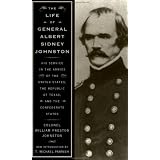
(More customer reviews)This biography of Albert Sidney Johnston, written by his son, first (and last, until now) appeared in 1878. William Preston, a professor of English and history at Washington (now Washington & Lee) College, had taken a five-year sabbatical from his duties to write it. William Preston, like his father, had served in the Confederate Army. He'd accompanied Jefferson Davis on his fight from Richmond, been captured along with him, was imprisoned for awhile by the Federals, lived for a year in self-exile in Canada, and eventually returned to the States to spend the rest of his life as a scholar. (In addition to his father's biography, William Preston wrote poetry and Shakespeare commentary.)
This massive biography of Albert Sidney has sometimes been dismissed as an exercise in Lost Cause hagiography. But I think that the judicious reader will dismiss the charge as overdone. It's certainly the case that William Preston admires his father. It's also the case that William Preston wants to argue that the loss of Forts Henry and Donelson, as well as the breaking of the "Confederate Department No. 2," the western theatre commanded by Johnston, really wasn't his father's fault. But this may not be filial loyalty so much as fact. The two forts were ill-built and commanded by incompetents, and the western theatre's front was over-extended and undermanned. It's also the case that Albert Sidney, fearing to give the game away to the Federals, had made inflated claims of strength to the press before Donelson and Henry, thus letting himself in for some fierce public criticism after they fell. Although this contributed to rumors of incompetence, the rumors were probably undeserved.
William Preston's biography is entirely readable, despite its huge size. It also has the advantage of quoting voluminously from General Johnston's correspondence, beginning with his Texas days, running through the Utah Expedition (of special interest to me), and ending in the Civil War. Finally, William Preston enlisted battle reports and personal reminiscences from many of the leaders in the Confederacy. If their opinions are sometimes slightly skewed, they're still intriguing--and important--insights into post-war interpretation.
All in all, a fascinating and enjoyable read.
Click Here to see more reviews about: The Life Of General Albert Sidney Johnston: Embracing His Services In The Armies Of The United States, The Republic Of Texas, And The Confederate States
When General Albert Sidney Johnston (1803–1862) fell mortally wounded at the Battle of Shiloh in April 1862, the Confederacy lost a man widely considered far superior in military ability to any commander, North or South. A graduate of West Point, Johnston served in the Black Hawk War, fought to secure Texas's independence from Mexico, served as secretary of war for the fledgling republic, won distinction during the Mexican War, commanded the elite Indian-fighting Second Cavalry, and subdued the Mormon Rebellion in 1861 Johnston was given command of Confederate operations in the West. Heavily outnumbered, and pitted against Ulysses S. Grant and William T. Sherman, Johnston seized the initiative and completely surprised the enemy at Shiloh till a stray bullet altered the course of battle and, in the eyes of many, the fate of a nation. Colonel William Preston Johnston, the general's son and Jefferson Davis's aide-de-camp, has written a rich and compelling biography of one of the Confederacy's greatest generals.


No comments:
Post a Comment