Average Reviews:

(More customer reviews)Albert Sidney Johnston is one of the most interesting generals of the Civil War. Johnston already had an extensive military record when the war began, and President Jefferson Davis (his old West Point classmate) personally saw to it that Johnston was given command of an entire army (the Army of the Mississippi, later the Army of Tennessee).
The problem with this was that Johnston had never commanded an army before, and now he was faced with defending a 500-mile-long border stretching from eastern kentucky to western Missouri. He had less than 50,000 "available" troops, and many were poorly armed and equipped (some units didn't have any weapons at all!).
The Union capture of Forts Henry and Donelson in February 1862 paved the way for the fall of Nashville, and soon nearly all of Tennessee was in Union hands. Desperate to reclaim Tennessee for the Confederacy, Johnston planned a bold strike on the Union forces gathered around Shiloh Church in southwest Tennessee.
On the morning of April 6, 1862, the Confederates charged into the surprised Union camps and for the rest of the day pushed them back towards the Tennessee River. But the Confederate assault had eventually come to a stop, thanks to the strong Union artillery position as well as an exhaustion of ammunition.
It was the first day of the Battle of Shiloh where Gen. Johnston was killed, the enemy bullet severing his femoral artery in his right leg. Isham Harris, the Confederate governor of Tennessee, was by his side as the general lay dying. Johnston had ignored the wound and had continued directing his troops, but within minutes he bled to death.
In his "Personal Memoirs", Gen. Ulysses S. Grant wrote, "I do not question the personal courage of General Johnston, or his ability, but he did not win the distinction predicted for him by many of his friends. He did prove that as a general he was over-estimated."
Had he survived the Battle of Shiloh, Gen. Johnston might have proven otherwise, but for the relatively short time he commanded the Army of the Mississippi he proved to be a brave yet unreliable leader. This book strongly defends his actions and is an in-depth look at his life and long military career. It is highly recommended for those who want to learn more about the first year of the Civil War in Tennessee, and for those wanting to know more about this interesting general.
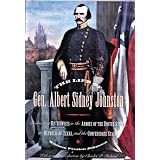
Click Here to see more reviews about: The Life of General Albert Sidney Johnston
The Life of Albert Sidney Johnston, selected by John H. Jenkins III as one of the basic Texas books, reads like a litany of the important events in the life of the Texas Republic and earlystatehood through the Civil War.A native Kentuckian and 1826 graduate of West Point, and a veteran of the Black Hawk War, Johnston arrived in Texas in 1836 shortly after the battle of San Jacinto and enlisted as a private in the Texas Army.Soon discovered in the ranks, he was immediately appointed the army's adjutant general.His injury from a duel with Felix Huston later prevented his taking command of the army.In 1838 he was appointed Texas' Secretary of War, and later led the expedition against the Cherokee Indians in East Texas.He commanded the 1st Texas Rifle Volunteers dring the Mexican War and became a regular officer in the U.S. Army--one of the few Texas military men permitted to do so.At the beginning of the Civil War in 1861, Johnston was offered aposition second in rank only to the aging Winfield Scott, but herefused the Federal government's offer and instead became commander of the Confederacy's Department No. 2, the Western Department. Keenly aware of the military weakness of the South, he issued a call for men at Bowling Green, Kentucky, and formed and drilled his army. On April 6, 1862, Johnston was killed at the battleof Shiloh.The author, Johnston's son, presents "a whole picture of the character of a difficult, generally taciturn man, and defends his actions in a balanced, scholarly manner."The son, having access to all of his father's private correspondence and papers, including his complete Confederate archives, was able to provide anecdotes only a son could know, and was able to persuade many of his father's associates to submit memoirs about him.Never before reprinted since its last publication in 1878, this newvolume is of inestimable value and interest to historians and to other readers of Civil War history and early Texas history.This edition contains a new introduction by Charles P. Roland, author of Albert Sidney Johnston: Soldier of Three Republics, and Jefferson Davis's Greatest General: Albert Sidney Johnston(McWhiney Foundation Press, 2000).
 Get 31% OFF
Click here for more information about The Life of General Albert Sidney Johnston

No comments:
Post a Comment